Pool Size Calculator: How Many Gallons Is My Pool?
If you've ever stood at the edge of your pool wondering exactly how much water is sitting in there, you're not alone. It's one of those numbers that seems impossible to guess and yet matters more than almost anything else when it comes to keeping your water balanced.
After spending years working with pool owners on everything from salt systems to chemical dosing, I can tell you that "I'm not sure how big my pool is" is one of the most common things I hear. And honestly, it makes sense. Unless you built the pool yourself or kept the spec sheet, that number just isn't something you think about day to day.
The good news? Figuring out your pool's gallons isn't complicated once you know the math. Let's walk through it.
Why You Need to Know Your Pool's Gallons
Your pool's volume is basically the foundation for every chemical decision you'll make. Without it, you're guessing, and guessing with pool chemicals tends to backfire.
Here's where that number actually matters:
Chemical dosing: Chlorine, shock, algaecide, pH adjusters, basically every product label tells you how much to add per 10,000 gallons. If you don't know your actual volume, you're either underdosing (and dealing with algae or cloudy water) or overdosing (and dealing with irritated skin, bleached swimsuits, or damaged equipment).
Salt water generator sizing: SWG units are rated for specific pool sizes. A generator rated for 15,000 gallons won't produce enough chlorine for a 30,000 gallon pool, and it'll be overkill (and run inefficiently) for a 10,000 gallon pool. Getting this wrong means either weak sanitation or a unit that wears out faster than it should.
Salt levels: This one's huge. Salt water pools need to sit within a specific salt range, usually somewhere between 2,700 and 3,400 ppm depending on your system. Adding salt is a one way street, you can dilute it by draining water, but you can't easily remove excess salt. So if you add salt based on the wrong gallon count, you could overshoot your target and end up with a much bigger headache, That's why it's worth learning how much salt to add to different pool sizes before you pour anything in.
This is exactly why getting your gallons right matters so much before you calculate your pool's gallons first once you have that number, you can calculate exactly how much salt to add once you know your gallons.
How to Calculate Pool Volume by Shape
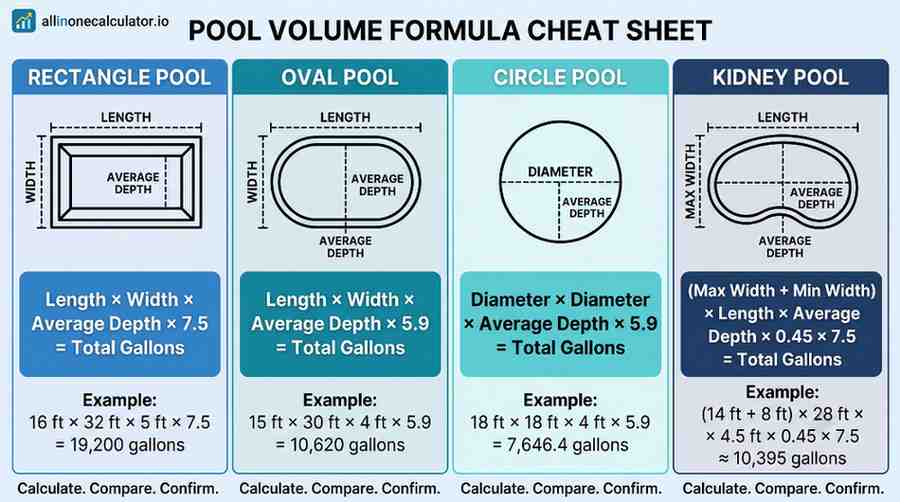
Every pool shape has its own formula, but they're all built on the same basic idea: figure out the surface area, multiply by the average depth, then multiply by 7.5 (the number of gallons in a cubic foot of water).
Rectangular or Square Pools
Formula: Length × Width × Average Depth × 7.5 = Gallons
This is the easiest shape to calculate because there's no guesswork involved with the area.
Example: Let's say you have a 16 ft × 32 ft pool with an average depth of 5 feet.
16 × 32 × 5 × 7.5 = 19,200 gallons
Oval Pools
Formula: Length × Width × Average Depth × 5.9 = Gallons
Oval pools use a slightly lower multiplier (5.9 instead of 7.5) because the rounded ends mean there's less actual water volume than a rectangle of the same dimensions would have.
Example: A 15 ft × 30 ft oval pool with an average depth of 4.5 feet.
15 × 30 × 4.5 × 5.9 = 11,947.5, so roughly 11,950 gallons
Round or Circular Pools
Formula: Diameter × Diameter × Average Depth × 5.9 = Gallons
Same multiplier as the oval, since you're again dealing with curves instead of straight edges.
Example: An 18 ft round pool with an average depth of 4 feet.
18 × 18 × 4 × 5.9 = 7,646.4, so roughly 7,650 gallons
Kidney or Freeform Pools
Formula: (Length × Width × Average Depth × 7.5) × 0.85 = Gallons
Freeform shapes don't have a clean formula because every one is a little different. The trick here is to treat it like a rectangle first using the longest length and widest width, then multiply by 0.85 to account for the curves and irregular edges cutting into that rectangular space.
Example: A kidney shaped pool that's roughly 18 ft long and 36 ft at its widest point, with an average depth of 5 feet.
18 × 36 × 5 × 7.5 = 24,300, then × 0.85 = 20,655 gallons
For pools with deep ends and shallow ends, your "average depth" is just the shallow depth plus the deep depth, divided by two. So a pool that's 3 feet at the shallow end and 8 feet at the deep end has an average depth of 5.5 feet.
Pool Size Calculator: How Many Gallons Is My Pool?
If you've ever stood at the edge of your pool wondering exactly how much water is sitting in there, you're not alone. It's one of those numbers that seems impossible to guess and yet matters more than almost anything else when it comes to keeping your water balanced.
After spending years working with pool owners on everything from salt systems to chemical dosing, I can tell you that "I'm not sure how big my pool is" is one of the most common things I hear. And honestly, it makes sense. Unless you built the pool yourself or kept the spec sheet, that number just isn't something you think about day to day.
The good news? Figuring out your pool's gallons isn't complicated once you know the math. Let's walk through it.
Why You Need to Know Your Pool's Gallons
Your pool's volume is basically the foundation for every chemical decision you'll make. Without it, you're guessing, and guessing with pool chemicals tends to backfire.
Here's where that number actually matters:
Chemical dosing. Chlorine, shock, algaecide, pH adjusters, basically every product label tells you how much to add per 10,000 gallons. If you don't know your actual volume, you're either underdosing (and dealing with algae or cloudy water) or overdosing (and dealing with irritated skin, bleached swimsuits, or damaged equipment).
Salt water generator sizing. SWG units are rated for specific pool sizes. A generator rated for 15,000 gallons won't produce enough chlorine for a 30,000 gallon pool, and it'll be overkill (and run inefficiently) for a 10,000 gallon pool. Getting this wrong means either weak sanitation or a unit that wears out faster than it should.
Salt levels. This one's huge. Salt water pools need to sit within a specific salt range, usually somewhere between 2,700 and 3,400 ppm depending on your system. Adding salt is a one way street, you can dilute it by draining water, but you can't easily remove excess salt. So if you add salt based on the wrong gallon count, you could overshoot your target and end up with a much bigger headache.
This is exactly why getting your gallons right matters so much before you touch a salt calculator, a chlorine dose, or anything else.
How to Calculate Pool Volume by Shape
Every pool shape has its own formula, but they're all built on the same basic idea: figure out the surface area, multiply by the average depth, then multiply by 7.5 (the number of gallons in a cubic foot of water).
Rectangular or Square Pools
Formula: Length × Width × Average Depth × 7.5 = Gallons
This is the easiest shape to calculate because there's no guesswork involved with the area.
Example: Let's say you have a 16 ft × 32 ft pool with an average depth of 5 feet.
16 × 32 × 5 × 7.5 = 19,200 gallons
Oval Pools
Formula: Length × Width × Average Depth × 5.9 = Gallons
Oval pools use a slightly lower multiplier (5.9 instead of 7.5) because the rounded ends mean there's less actual water volume than a rectangle of the same dimensions would have.
Example: A 15 ft × 30 ft oval pool with an average depth of 4.5 feet.
15 × 30 × 4.5 × 5.9 = 11,947.5, so roughly 11,950 gallons
Round or Circular Pools
Formula: Diameter × Diameter × Average Depth × 5.9 = Gallons
Same multiplier as the oval, since you're again dealing with curves instead of straight edges.
Example: An 18 ft round pool with an average depth of 4 feet.
18 × 18 × 4 × 5.9 = 7,646.4, so roughly 7,650 gallons
Kidney or Freeform Pools
Formula: (Length × Width × Average Depth × 7.5) × 0.85 = Gallons
Freeform shapes don't have a clean formula because every one is a little different. The trick here is to treat it like a rectangle first using the longest length and widest width, then multiply by 0.85 to account for the curves and irregular edges cutting into that rectangular space.
Example: A kidney shaped pool that's roughly 18 ft long and 36 ft at its widest point, with an average depth of 5 feet.
18 × 36 × 5 × 7.5 = 24,300, then × 0.85 = 20,655 gallons
For pools with deep ends and shallow ends, your "average depth" is just the shallow depth plus the deep depth, divided by two. So a pool that's 3 feet at the shallow end and 8 feet at the deep end has an average depth of 5.5 feet.
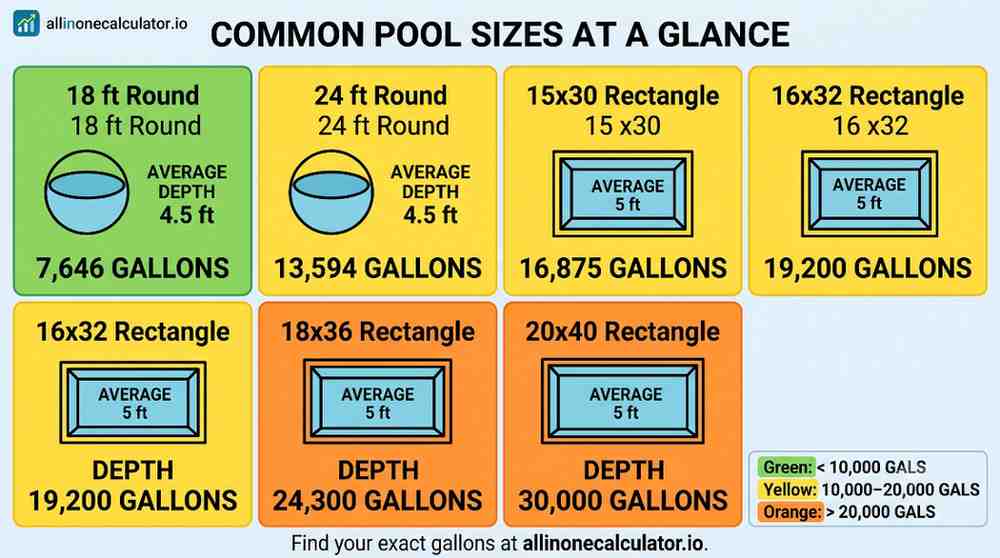
Common Pool Sizes and Their Gallons
If you'd rather skip the math entirely and your pool is a fairly standard size, here's a quick reference table based on typical average depths.
Pool Shape | Dimensions | Average Depth | Gallons |
|---|---|---|---|
Round | 18 ft | 4 ft | ~7,650 |
Round | 24 ft | 4.5 ft | ~15,300 |
Rectangular | 15 × 30 ft | 5 ft | ~16,875 |
Rectangular | 16 × 32 ft | 5 ft | ~19,200 |
Rectangular | 18 × 36 ft | 5.5 ft | ~26,730 |
Rectangular | 20 × 40 ft | 5.5 ft | ~33,000 |
Keep in mind these are estimates based on average depth assumptions. If your pool has a noticeably deep end or a shallow tanning ledge, your actual number could shift by a few hundred to a couple thousand gallons either direction. When in doubt, run your own numbers using the formulas above with your pool's actual depths.
Above-Ground Pool Gallons by Size
Above ground pools are a little more predictable than in ground pools because most of them come in standardized sizes from manufacturers. Almost all above ground pools are either round or oval, and the depth is usually consistent across the whole pool since there's no deep end.
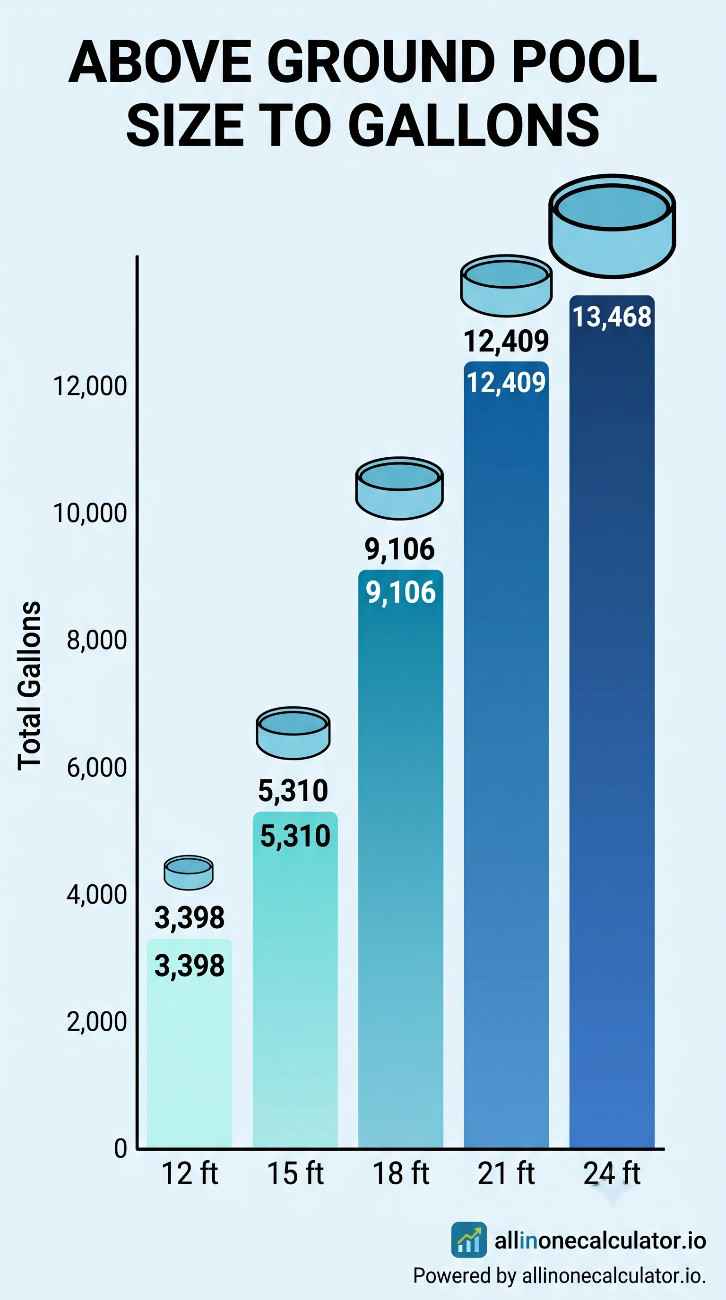
Here's what the most common sizes typically hold:
Size | Shape | Typical Depth | Gallons |
|---|---|---|---|
12 ft round | Round | 48 in | ~3,398 |
15 ft round | Round | 48 in | ~5,310 |
18 ft round | Round | 52 in | ~9,106 |
21 ft round | Round | 52 in | ~12,409 |
24 ft round | Round | 52 in | ~13,468 |
12 × 24 ft oval | Oval | 48 in | ~6,797 |
15 × 30 ft oval | Oval | 52 in | ~11,520 |
One thing worth mentioning: above ground pool depth is usually measured as the wall height, but the actual water level sits a few inches below the top of the wall (you don't want to fill it all the way). Most manufacturers already account for this in their published gallon figures, but if you're calculating manually, use the actual water depth, not the wall height.
Hot Tub and Spa Volume
Hot tubs are small enough that gallons are usually listed right in the owner's manual or on a sticker near the equipment panel, but if you can't find that info, here's a rough breakdown by typical size:
2 to 3 person spa: roughly 200 to 300 gallons
4 to 5 person spa: roughly 300 to 450 gallons
6 to 8 person spa: roughly 450 to 600 gallons
If you want to calculate it yourself, the same rectangular or round formulas from earlier work fine for spas too, just keep in mind that seats and jets take up some of that space, so your actual number will be a bit lower than the raw calculation suggests. Subtracting around 10% from your calculated volume usually gets you close to reality.
How to Find Your Pool Volume Without Measuring
If measuring your pool sounds like more effort than you want to deal with, there are a few shortcuts that might already have your answer waiting for you.
If you're setting up a new salt system for the first time, this volume number is also your starting point for converting from chlorine to saltwater.
Check your pool builder's spec sheet. If your pool was professionally installed, the contract or construction documents almost always list the exact gallon capacity. This is usually the most accurate number you'll find since it's based on the actual excavation and build, not estimates.
Look at your salt water generator manual. SWG units are sized for specific gallon ranges, and if yours was properly sized for your pool, the manual or the unit's settings panel may reference the gallon range it was installed for. This isn't always exact, but it can give you a solid ballpark.
Check your filter or pump system documentation. Sometimes equipment specs reference the recommended pool size, which can help you back into an approximate gallon count if nothing else is available.
Ask whoever installed your liner or above ground pool kit. Above ground pool kits almost always come with the gallons listed on the box or in the manual, so if you still have that paperwork (or can find the model number and look it up), you're set.
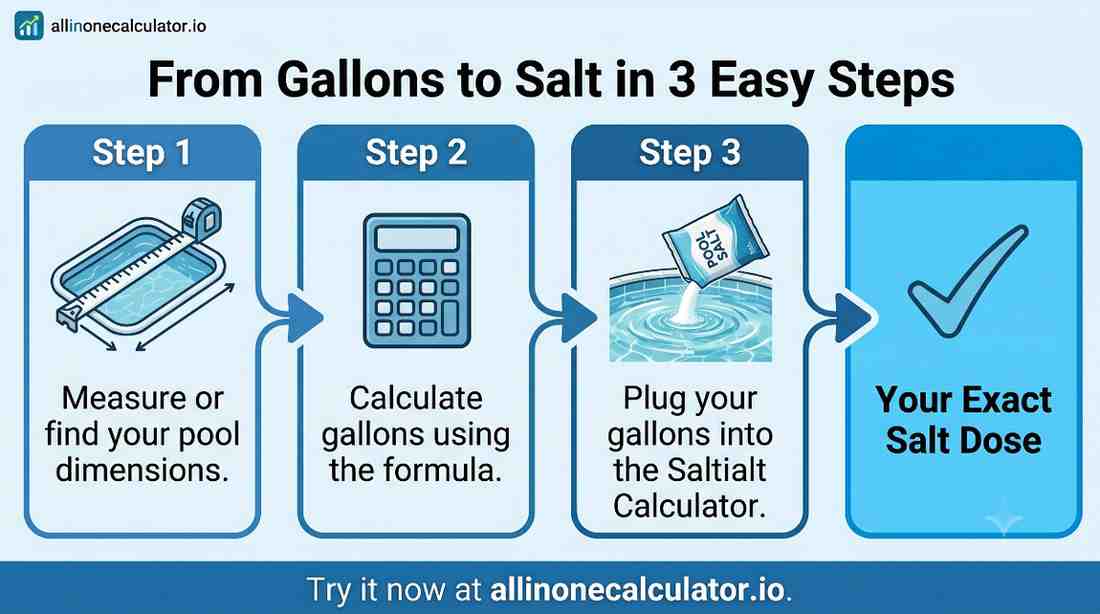
Once you have a gallon number you trust, whether from your own measurements or from a spec sheet, you're ready for the part that actually matters: figuring out how much salt your pool needs.
Once you have your gallons, plug them into our Pool Salt Calculator to find your exact salt dose.
Getting your pool volume right is the foundation for everything else, accurate salt levels, proper chemical dosing, and a salt system that runs the way it's supposed to. Take a few minutes to measure or track down your real number, and the rest of your pool maintenance gets a whole lot easier.
Was this article helpful?