How Much Salt Does My Pool Need? (By Size, From 0 PPM and Top-Up)
If you own a saltwater pool, one of the most common questions you will face is exactly how much salt to add and when. Too little salt and your salt chlorine generator struggles to produce enough chlorine to keep the water clean. Too much and you risk damaging an expensive piece of equipment. Getting the number right the first time saves you money, protects your SWG cell, and keeps your pool water balanced all season.
This guide breaks down salt requirements by pool size, covers both new fills starting at zero and existing pools that need a top-up, and walks you through the correct way to add salt so it dissolves properly and reads accurately on your next test.
If you want the fastest answer, use our Pool Salt Calculator to get your exact pound and bag count in seconds based on your pool's volume and current PPM reading.
Why Getting the Salt Amount Right Matters
Salt chlorine generators are built to operate within a specific salinity window. Most major US brands, including Hayward, Pentair, and Jandy, recommend keeping your pool between 2,700 and 3,400 PPM, with 3,200 PPM being the sweet spot that most units are calibrated around.
When salt levels drop below 2,700 PPM, your SWG begins cutting back chlorine output to protect itself. Push it further down and the unit shuts off entirely, leaving your pool without active sanitation. Run it in that state long enough and you are looking at a shortened cell lifespan and repair costs that dwarf a few extra bags of salt.
On the flip side, consistently running above 3,500 PPM puts unnecessary stress on your salt cell, speeds up corrosion on metal pool fittings and ladders, and can make the water taste noticeably salty to swimmers. Some SWG units will trigger a high-salt warning and reduce output just as they would at low levels.
The target is a narrow band, and hitting it accurately every time is what this guide is designed to help you do.
How Much Salt for a New Pool Starting at 0 PPM
If you are filling a pool from scratch with fresh water, your starting salinity is effectively zero. Fresh tap water contains trace minerals but essentially no salt at pool-relevant levels, so you are calculating the full dose from the ground up.
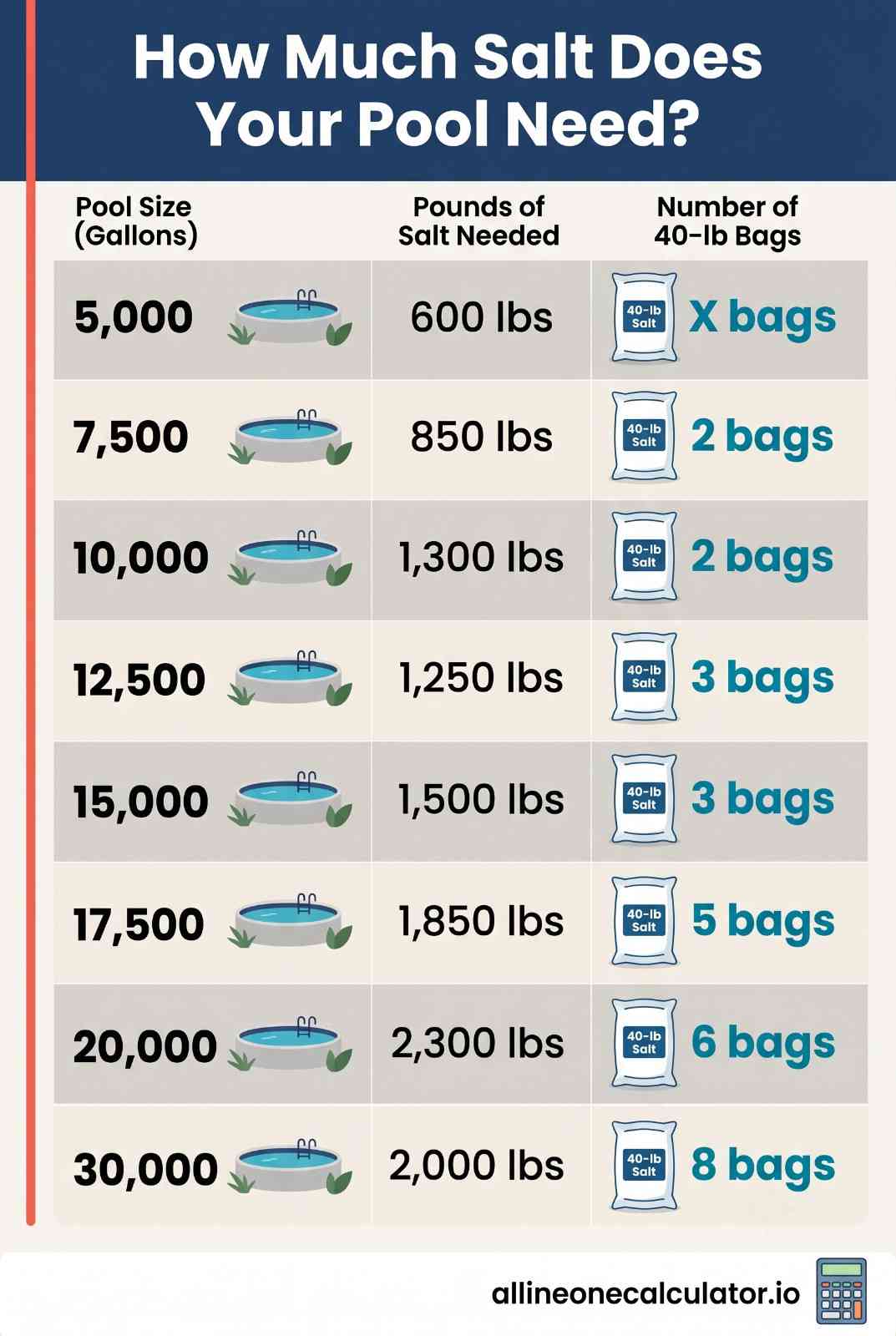
The math behind this is straightforward. You need approximately 8.33 lbs of pool-grade salt per 10,000 gallons to raise salinity by 1,000 PPM. To reach 3,200 PPM, multiply that by 3.2, which gives you roughly 26.7 lbs per 1,000 gallons of pool water.
The table below does this math for the most common residential pool sizes so you know exactly what to buy before you even leave the house.
Salt Required to Reach 3,200 PPM from 0 PPM
Pool Size (Gallons) | Salt Needed (lbs) | 40-lb Bags Needed |
|---|---|---|
5,000 | 134 | 4 bags |
10,000 | 267 | 7 bags |
12,000 | 320 | 8 bags |
15,000 | 400 | 10 bags |
18,000 | 481 | 13 bags |
20,000 | 534 | 14 bags |
25,000 | 668 | 17 bags |
30,000 | 801 | 21 bags |
Bag counts are rounded up to the nearest whole bag since you cannot buy a partial bag at Home Depot or Lowe's. It is always better to have one bag left over than to fall 20 lbs short and need a second trip.
Not sure of your pool's exact gallon count? Check out our Pool Size Calculator to get an accurate volume before running your salt dose calculation.
If your pool is an irregular shape or you are working from a pool builder's spec sheet, use the exact figure provided rather than estimating. Even a 1,000-gallon error translates to roughly one full bag of salt, which can push you above or below the ideal range.
Once you know your pool size, plug it into our Pool Salt Calculator along with your current PPM reading to get your personalized pound and bag count without doing any of the math yourself.
How Much Salt to Add for a Top-Up
Most pool owners are not starting from zero. You have an existing pool with some salt already in the water, and after a rainy stretch, a partial drain and refill, or a full summer of evaporation and splash-out, your PPM has dropped below where it needs to be. In this case you are not filling from scratch. You are only adding what is missing.
The Gap Formula
The calculation works like this:
Take the difference between your target PPM and your current PPM. Multiply that difference by your pool volume in gallons. Divide by 1,000,000 to convert PPM to a decimal. Then multiply by 8.33 lbs (the weight of a gallon of water) to get your salt requirement in pounds.
Written out simply:
Salt needed (lbs) = (Target PPM - Current PPM) x Pool Gallons / 1,000,000 x 8.33
Real Examples
Example 1: Your 15,000-gallon pool tested at 2,800 PPM. Your target is 3,200 PPM. The gap is 400 PPM.
400 x 15,000 / 1,000,000 x 8.33 = 49.98 lbs, rounded up to 50 lbs, which is 2 bags.
Example 2: Your 20,000-gallon pool dropped to 2,200 PPM after a wet spring. Your target is 3,200 PPM. The gap is 1,000 PPM.
1,000 x 20,000 / 1,000,000 x 8.33 = 166.6 lbs, which is 5 bags with a small amount left over.
Example 3: Your 10,000-gallon pool reads 3,000 PPM. You only need to add 200 PPM worth of salt.
200 x 10,000 / 1,000,000 x 8.33 = 16.66 lbs, so one half bag. In practice most people buy one full 40-lb bag and store the remainder for the next top-up.
How Much Salt Does My Pool Need? (By Size, From 0 PPM and Top-Up)
If you own a saltwater pool, one of the most common questions you will face is exactly how much salt to add and when. Too little salt and your salt chlorine generator struggles to produce enough chlorine to keep the water clean. Too much and you risk damaging an expensive piece of equipment. Getting the number right the first time saves you money, protects your SWG cell, and keeps your pool water balanced all season.
This guide breaks down salt requirements by pool size, covers both new fills starting at zero and existing pools that need a top-up, and walks you through the correct way to add salt so it dissolves properly and reads accurately on your next test.
If you want the fastest answer, use our Pool Salt Calculator to get your exact pound and bag count in seconds based on your pool's volume and current PPM reading.
Why Getting the Salt Amount Right Matters
Salt chlorine generators are built to operate within a specific salinity window. Most major US brands, including Hayward, Pentair, and Jandy, recommend keeping your pool between 2,700 and 3,400 PPM, with 3,200 PPM being the sweet spot that most units are calibrated around.
When salt levels drop below 2,700 PPM, your SWG begins cutting back chlorine output to protect itself. Push it further down and the unit shuts off entirely, leaving your pool without active sanitation. Run it in that state long enough and you are looking at a shortened cell lifespan and repair costs that dwarf a few extra bags of salt.
On the flip side, consistently running above 3,500 PPM puts unnecessary stress on your salt cell, speeds up corrosion on metal pool fittings and ladders, and can make the water taste noticeably salty to swimmers. Some SWG units will trigger a high-salt warning and reduce output just as they would at low levels.
The target is a narrow band, and hitting it accurately every time is what this guide is designed to help you do.
How Much Salt for a New Pool Starting at 0 PPM
If you are filling a pool from scratch with fresh water, your starting salinity is effectively zero. Fresh tap water contains trace minerals but essentially no salt at pool-relevant levels, so you are calculating the full dose from the ground up.
The math behind this is straightforward. You need approximately 8.33 lbs of pool-grade salt per 10,000 gallons to raise salinity by 1,000 PPM. To reach 3,200 PPM, multiply that by 3.2, which gives you roughly 26.7 lbs per 1,000 gallons of pool water.
The table below does this math for the most common residential pool sizes so you know exactly what to buy before you even leave the house.
Salt Required to Reach 3,200 PPM from 0 PPM
Pool Size (Gallons) | Salt Needed (lbs) | 40-lb Bags Needed |
|---|---|---|
5,000 | 134 | 4 bags |
10,000 | 267 | 7 bags |
12,000 | 320 | 8 bags |
15,000 | 400 | 10 bags |
18,000 | 481 | 13 bags |
20,000 | 534 | 14 bags |
25,000 | 668 | 17 bags |
30,000 | 801 | 21 bags |
Bag counts are rounded up to the nearest whole bag since you cannot buy a partial bag at Home Depot or Lowe's. It is always better to have one bag left over than to fall 20 lbs short and need a second trip.
Don’t know what’s you pool water size, check out this blog on how to calculate your pool's gallons first.
Not sure of your pool's exact gallon count? Check out our Pool Size Calculator to get an accurate volume before running your salt dose calculation.
If your pool is an irregular shape or you are working from a pool builder's spec sheet, use the exact figure provided rather than estimating. Even a 1,000-gallon error translates to roughly one full bag of salt, which can push you above or below the ideal range.
Once you know your pool size, plug it into our Pool Salt Calculator along with your current PPM reading to get your personalized pound and bag count without doing any of the math yourself.
How Much Salt to Add for a Top-Up
Most pool owners are not starting from zero. You have an existing pool with some salt already in the water, and after a rainy stretch, a partial drain and refill, or a full summer of evaporation and splash-out, your PPM has dropped below where it needs to be. In this case you are not filling from scratch. You are only adding what is missing.
The Gap Formula
The calculation works like this:
Take the difference between your target PPM and your current PPM. Multiply that difference by your pool volume in gallons. Divide by 1,000,000 to convert PPM to a decimal. Then multiply by 8.33 lbs (the weight of a gallon of water) to get your salt requirement in pounds.
Written out simply:
Salt needed (lbs) = (Target PPM - Current PPM) x Pool Gallons / 1,000,000 x 8.33
Real Examples
Example 1: Your 15,000-gallon pool tested at 2,800 PPM. Your target is 3,200 PPM. The gap is 400 PPM.
400 x 15,000 / 1,000,000 x 8.33 = 49.98 lbs, rounded up to 50 lbs, which is 2 bags.
Example 2: Your 20,000-gallon pool dropped to 2,200 PPM after a wet spring. Your target is 3,200 PPM. The gap is 1,000 PPM.
1,000 x 20,000 / 1,000,000 x 8.33 = 166.6 lbs, which is 5 bags with a small amount left over.
Example 3: Your 10,000-gallon pool reads 3,000 PPM. You only need to add 200 PPM worth of salt.
200 x 10,000 / 1,000,000 x 8.33 = 16.66 lbs, so one half bag. In practice most people buy one full 40-lb bag and store the remainder for the next top-up.
The gap formula works for any starting and ending PPM combination. The key is getting an accurate current reading before you calculate. Test strips are convenient but tend to be less precise for salt than a digital salt meter or your SWG's built-in sensor. If you are making a significant adjustment, a digital reading is worth the extra minute.
How Rain and Splash-Out Reduce Salt Levels
Salt does not evaporate. When your pool water evaporates in the summer heat, the salt stays behind, which actually concentrates the salinity slightly. The real culprits behind dropping PPM are dilution events, and there are three main ones.
Rainfall is the biggest one for most pool owners. A heavy rainstorm can dump thousands of gallons of fresh, salt-free water into your pool in a matter of hours. A pool that tested at 3,200 PPM on Monday can easily be sitting at 2,800 PPM or lower by the weekend after a significant rain event. Pool owners in the Southeast US, Gulf Coast states, and Florida deal with this regularly throughout summer and hurricane season.
Splash-out happens gradually but consistently, especially in pools with active kids, high swimmer loads, or water features. Every gallon of pool water that leaves the pool takes its dissolved salt with it, and it gets replaced by your garden hose with fresh water during top-offs. Over a full swim season, this can account for a meaningful drop in salinity.
Partial drain and refill is the most significant single dilution event. Any time you drain a portion of your pool water and refill with fresh water, you are directly diluting your salt concentration. Even draining 20 to 30 percent of the water, which is common for water chemistry resets, will push your PPM down noticeably.
How Often to Test
For most pool owners in warm US climates, testing salt levels once a month during swim season is a reasonable baseline. After any significant rainfall or a drain-and-refill event, test again before assuming your levels are still where you left them.
If your SWG has a built-in salt reading on its display, glance at it weekly. It will usually give you an early warning that levels are trending low before they reach the point where chlorine output is affected.
For a full walkthrough, see how to test your current salt level.
Step-by-Step: How to Add Salt to a Pool Correctly
Adding salt sounds simple but doing it the wrong way leads to undissolved salt sitting on your pool floor, falsely low PPM readings, and in some cases surface staining. Here is the right process.
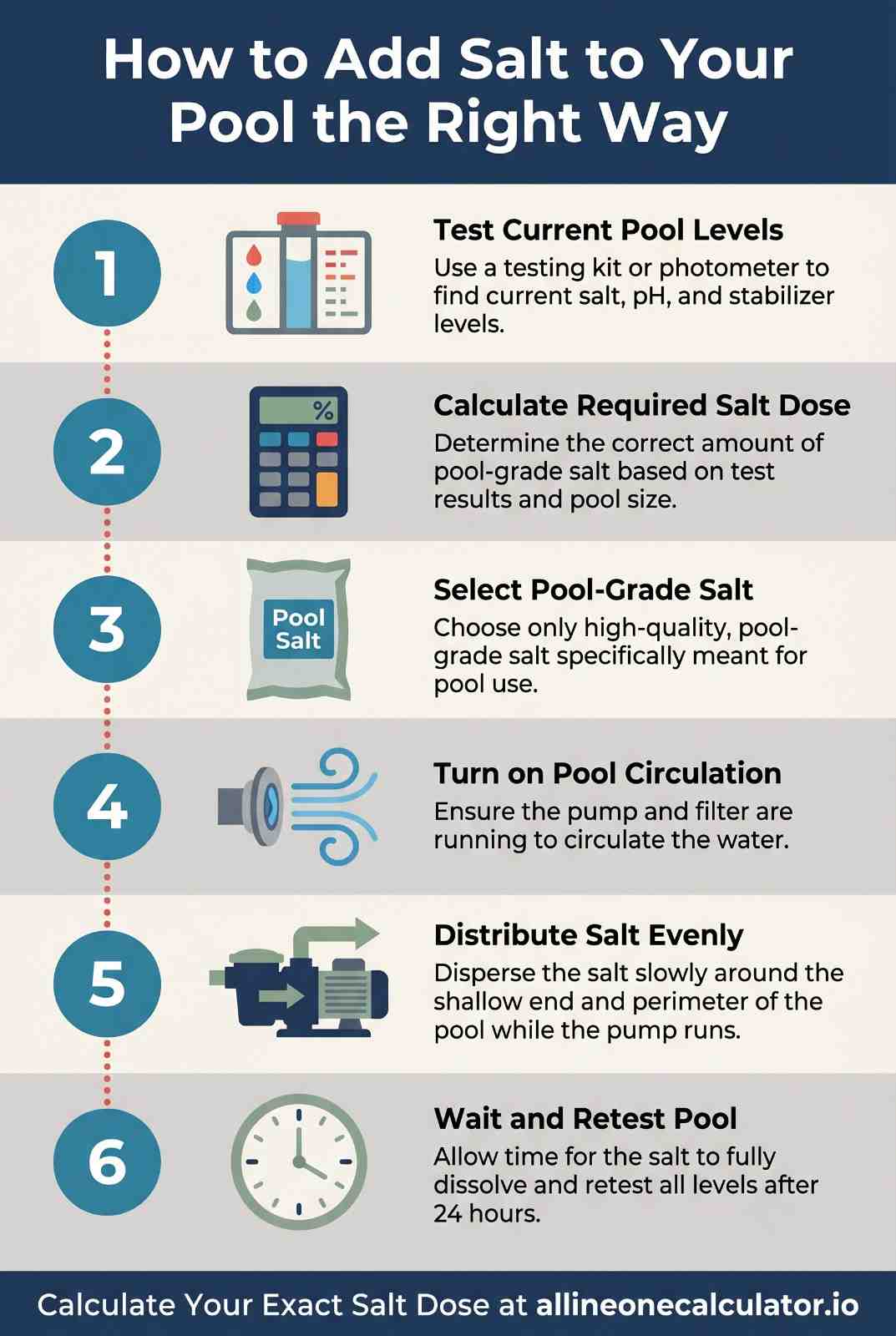
Step 1: Test your water first. Before you buy a single bag, get an accurate current PPM reading. Use a digital salt tester or check your SWG display. This tells you exactly how much salt you actually need rather than guessing.
Step 2: Calculate your dose. Use the table above for a new fill, or use the gap formula for a top-up. Alternatively, run your numbers through our Pool Salt Calculator to get the exact pounds and bag count based on your specific pool volume and current reading.
Step 3: Buy pool-grade salt only. Use sodium chloride that is at least 99.8 percent pure and labeled specifically for pool use or water softener use. Avoid rock salt, iodized table salt, or any salt with additives like anti-caking agents, as these can cloud your water or leave staining deposits.
Step 4: Pour salt near the return jets. Walk around the perimeter of your pool and pour the salt slowly along the edges, concentrating near the return jets where water circulation is strongest. Avoid pouring directly in front of your skimmer or in one large pile in a single spot.
Step 5: Run your pump continuously for at least 24 hours. Salt dissolves and distributes through circulation, not just by sitting in water. Your pump needs to be running to move the dissolved salt through the entire pool volume and back through the SWG cell. Do not skip this step.
Step 6: Brush any undissolved salt off the pool floor. If you can see salt granules sitting on the bottom, gently brush them toward a return jet to help them dissolve faster. Do not let salt sit concentrated on a vinyl liner or plaster surface for extended periods.
Step 7: Wait before re-testing. Test your water again after the pump has run for a full 24 hours. Testing too soon will give you a reading that is lower than your actual level because not all the salt has fully dissolved and circulated yet.
How Long to Wait Before Swimming After Adding Salt
This is one of the most common questions people ask after their first salt addition, and the good news is that the wait time is short.
You can swim as soon as the salt has fully dissolved and the pump has been running for a minimum of 30 minutes. There is nothing in pool-grade salt that requires a longer waiting period from a swimmer safety standpoint. Salt is not a chemical treatment like chlorine shock or algaecide that needs time to dissipate.
That said, most pool professionals recommend waiting until after the full 24-hour pump cycle before swimming, not for safety reasons, but for practical ones. Running the pump for 24 hours ensures the salt is evenly distributed throughout the pool, which means your SWG is seeing a consistent salinity level and your readings will be accurate. If you swim during that period and splash a lot of water out, you are also removing some of the salt you just paid for before it has fully circulated.
If your pool is your primary summer activity and waiting 24 hours is not realistic, swimming after a couple of hours is safe. Just plan to test your levels the following day once everything has had time to fully mix.
Frequently Asked Questions
How much salt do I need for a 10,000 gallon pool?
A 10,000-gallon pool starting from fresh water with 0 PPM needs approximately 267 lbs of pool salt to reach 3,200 PPM, which works out to 7 standard 40-lb bags. If your pool already has some salt in it, subtract your current PPM from 3,200, then use the gap formula to find the reduced amount you actually need to add.
How much salt do I need for a 20,000 gallon pool?
A 20,000-gallon pool starting from 0 PPM requires approximately 534 lbs of salt to reach 3,200 PPM, which is 14 bags of 40-lb pool salt. For top-ups, calculate the difference between your current reading and 3,200 PPM and multiply by your pool volume using the formula above.
Can I add too much salt to my pool?
Yes. If your salt level climbs above 3,500 to 4,000 PPM, most SWG units will trigger a high-salt warning and some will reduce or shut down chlorine production. Consistently high salinity also accelerates corrosion on metal pool equipment and fittings. The only fix for over-salted water is dilution, which means draining a portion of the pool and replacing it with fresh water. You cannot remove salt with a chemical treatment.
What kind of salt should I use in a saltwater pool?
Use sodium chloride that is at least 99.8 percent pure and specifically sold as pool salt or water softener salt. The salt should be free of iodine, anti-caking agents, and other additives. Brands sold at pool supply stores, Home Depot, and Lowe's labeled as pool salt are all suitable. Avoid rock salt or any food-grade salt that contains additives.
If you're switching pool types altogether, read our guide on converting from chlorine to saltwater.
How often should I add salt to my pool?
Most saltwater pools need salt added two to three times per season, typically after significant rainfall, after a partial drain and refill, or at the start of the season when levels may have dropped over winter. Salt does not break down or wear out, so in a well-maintained pool with minimal dilution events, you may only need a single top-up per season. Test monthly and after any major water addition to stay ahead of drops before your SWG starts warning you.
Keeping your saltwater pool at the right salinity is one of the easiest parts of pool maintenance once you understand how the numbers work. The hardest part is usually just knowing how many bags to buy before you get to the store.
Use our Pool Salt Calculator to get your exact salt requirement based on your pool's volume and current PPM, and you will always know the precise answer before you make the trip.
Was this article helpful?