Pool Salt vs. Water Softener Salt: Can You Use Them Interchangeably?
TL;DR
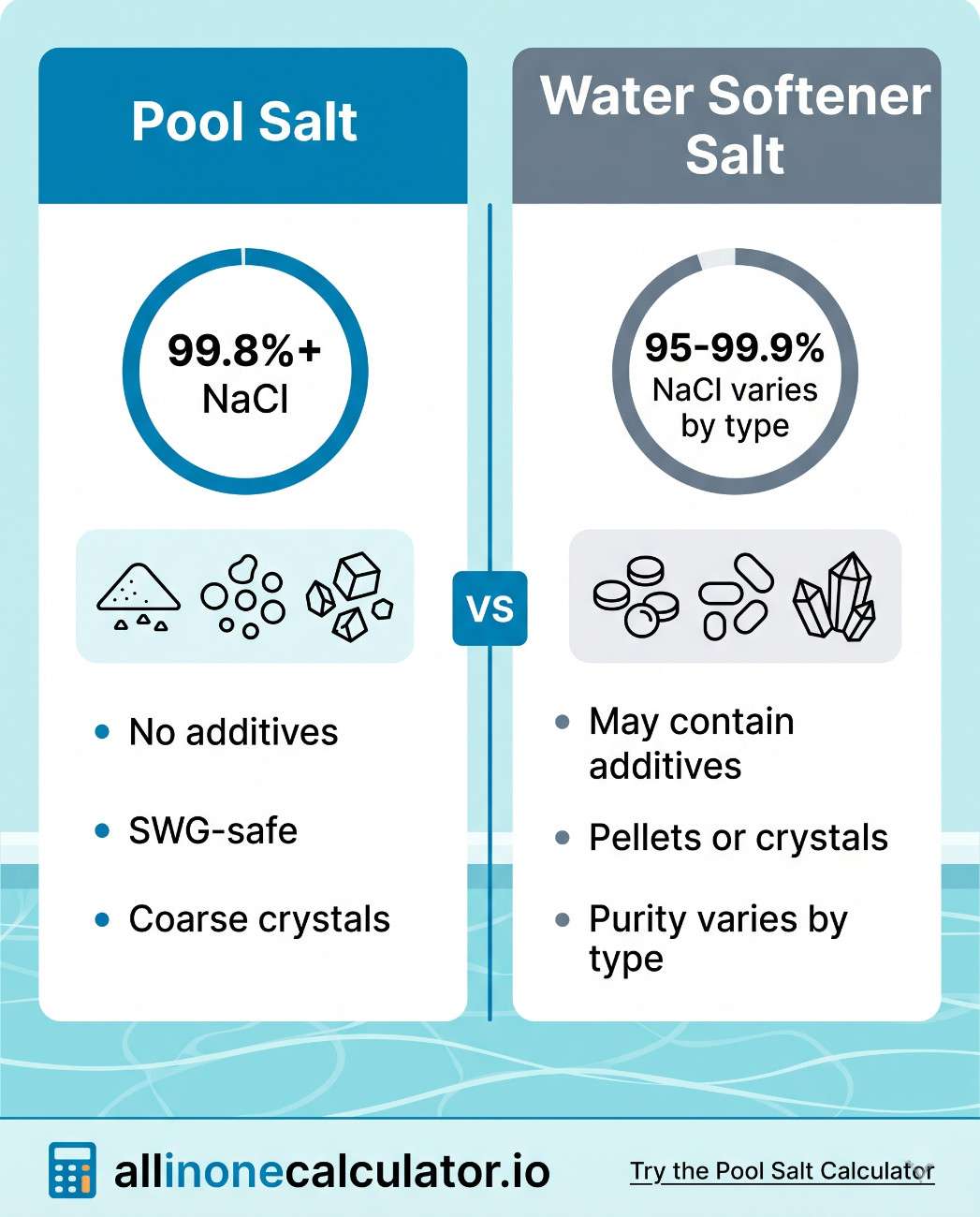
Pool salt and water softener salt are both sodium chloride (NaCl), but they're refined and tested to different standards.
Pool salt for saltwater chlorinators needs to be at least 99.8% pure with no anti-caking agents, iron, or other additives that can stain a pool or clog equipment.
Water softener salt purity varies a lot. Rock salt can be as low as 95-98% pure, while solar and evaporated salt run closer to 99.5-99.9%.
Water softener salt labeled "evaporated" or "solar" and rated 99.5%+ pure with no additives can technically work in a pool, but pool-grade salt is still the safer, recommended choice.
Pool salt can go into a water softener too, but it's usually a more expensive and less practical option for that job.
Brands made specifically for pools, like Diamond Crystal Splash Ready, Morton Pool Salt, and Clorox Pool Salt, take the guesswork out entirely.
If you've ever stood in the water treatment aisle holding a 40 lb bag of softener salt in one hand and pool salt in the other, wondering if they're really different products or just different marketing, you're not alone. They look the same. They feel the same. The price tags don't even tell a clear story. So let's settle it.
What pool salt actually is (NaCl purity requirements for SWG pools)
Pool salt exists for one job: feeding a salt water chlorine generator (SWG), the system that converts dissolved salt into chlorine through electrolysis. Because that conversion happens inside a cell with metal plates, the salt going into your pool needs to be extremely clean.
Most manufacturers require pool salt to be at least 99.8% pure sodium chloride, with no anti-caking agents, no iron, no copper, and no added minerals. Those impurities aren't just a minor inconvenience. Iron can stain plaster or vinyl a rust color, calcium contributes to scale buildup on the chlorinator cell, and anti-caking additives (commonly used in table salt and some softener salts) can leave a cloudy residue or coat the generator's plates, shortening its lifespan.
This is also why pool salt is usually sold as coarse granules or fine evaporated crystals rather than pellets. The goal is fast, clean dissolving with nothing left behind.
What water softener salt is (pellets vs. crystals, additives, purity differences)
Water softener salt is built for a completely different job: regenerating the resin beads inside a softener's brine tank so they can keep pulling calcium and magnesium out of your household water. Because that process doesn't involve electrolysis or pool surfaces, purity standards are more relaxed.
You'll generally find three types:
Rock salt is mined rather than evaporated, and it's the least pure option, often only 95-98% NaCl. It contains natural sediment and minerals, which is part of why it's the cheapest softener salt on the shelf.
Solar salt is produced by evaporating seawater in the sun. It's purer than rock salt, typically in the 99.5-99.6% range, and comes in crystal or pellet form.
Evaporated salt goes through a mechanical evaporation process and is the purest commercially available option, often 99.9%+ NaCl. This is the closest match to pool salt in terms of cleanliness.
Some softener salt products also include additives like rust removers or potassium chloride blends, which are useful for softeners dealing with iron-heavy well water, but those same additives are exactly what you don't want flowing through a saltwater pool system.
Can you use water softener salt in a pool? The short answer
Water softener salt labeled "evaporated" or "solar" and rated 99.5% or higher pure NaCl, with no additives, can technically work in a pool. Pool-grade salt is still safer and the recommended choice.
If you check the bag and it says "evaporated salt," "solar salt," or "extra coarse solar salt" with no mention of rust removers, iron fighters, or potassium chloride, the purity is usually close enough to pool salt that most SWG manufacturers won't flag it as a problem. People do this successfully, especially when pool salt is temporarily out of stock or priced unusually high.
The catch is consistency. Pool salt brands are tested specifically for SWG compatibility and labeled accordingly, so you know exactly what you're putting into a system with expensive metal components. Softener salt brands aren't held to that same standard because that's not what they're designed for, so purity can vary between batches even within the same brand. Rock salt, in particular, should be avoided entirely for pools since the insoluble matter it leaves behind can cloud the water and settle as sediment on the pool floor.
If cost is the only reason you're considering the swap, it's worth running the numbers first. Pool salt usually isn't dramatically more expensive once you compare it apples to apples with high-purity evaporated softener salt.
Can you use pool salt in a water softener?
Yes, technically, but there are a few practical issues that make it a less ideal choice.
Pool salt is almost always sold as granules or crystals, not pellets. Many modern water softeners are designed around pellet salt because pellets compact less and create fewer salt bridges (hardened crusts that form in the brine tank and stop the regeneration cycle from working properly). Crystal or granular salt can still work in some softener models, but it increases the chances of bridging or mushing, which means more maintenance for you.
There's also the additive issue in reverse. If your home's water has iron problems, you'd normally buy a softener salt with rust-removing additives to handle it. Pool salt has none of that, so you'd lose a feature you might actually need.
And then there's cost. Pool salt is typically priced for a smaller, more specialized market, so per-pound it often costs more than basic softener salt for the same or lower benefit in a softener application.
Why pool salt costs different from water softener salt
The price gap between pool salt and water softener salt comes down to three things: purity, processing, and market size.
Higher purity costs more to produce. Getting sodium chloride above 99.8% with zero additives requires tighter quality control during evaporation and packaging, and that cost gets passed along.
Water softener salt is also produced and sold at a much larger scale. Nearly every home with hard water needs softener salt year-round, while pool salt demand is seasonal and regional, mostly limited to homeowners running saltwater pools. Lower volume production generally means higher per-unit pricing.
Finally, packaging and labeling for pool-specific products often includes additional testing and SWG-compatibility guarantees that softener salt manufacturers don't need to provide.
Which salt brands to use for your pool
If you'd rather skip the purity-label detective work, these are reliable, pool-specific options:
Diamond Crystal Splash Ready is formulated specifically for saltwater pools, with high purity and fast dissolving, making it a solid no-research-needed choice for most SWG systems.
Morton Pool Salt is widely available and consistently meets the purity standards most chlorinator manufacturers require, with minimal insoluble residue.
Clorox Pool Salt is another evaporated, high-purity option built for swimming pools, often sold in bulk bags that make seasonal salt-ups more affordable.
Any of these three takes the guesswork out and protects your SWG system's warranty, since most manufacturers specifically recommend pool-rated salt to keep coverage valid.
Frequently Asked Questions
Is pool salt the same as water softener salt?
Not exactly. Both are sodium chloride, but pool salt is refined to a higher, more consistent purity (99.8%+) with no additives, while water softener salt purity and additive content vary by type and brand.
Can I use pool salt in my water softener?
Yes, it's usually safe, but pool salt's granular form can cause salt bridging in pellet-designed softeners, and it lacks additives like rust removers that some softener salts include.
Can I use water softener salt in my pool?
Evaporated or solar softener salt rated 99.5%+ pure with no additives can work, but pool-grade salt remains the safer, recommended option for saltwater chlorine generators.
What's the best water softener salt for swimming pools?
If you're substituting in a pinch, look for "evaporated" or "solar" salt with no additives and the highest purity percentage on the label. For regular use, a dedicated pool salt brand is still the better choice.
Not sure how much salt your pool actually needs before you buy a bag? Calculate exactly how much salt to add once you know your gallons.
If you're thinking about switching from chlorine tablets to a saltwater system altogether, our guide on converting from chlorine to saltwater walks through what that actually involves.
Was this article helpful?