How to Test Pool Salt Levels (Test Strips vs. Digital Testers vs. SWG Display)
TL;DR
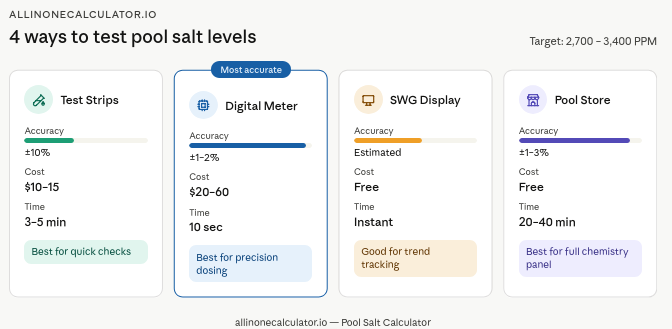
There are four ways to test your pool's salt level: AquaChek or Clorox salt test strips (fast, affordable, +/- 10% accuracy), a digital salinity meter (most accurate, $15-60), your SWG's built-in display (convenient but needs calibration), and a free pool store water test. Ideal salt level for most salt pools is 2,700-3,400 PPM. Once you have your reading, use the Pool Salt Calculator to figure out exactly how much salt to add.
Why Accurate Salt Testing Matters Before You Add Anything
Salt pool chemistry is unforgiving in one direction: adding too much salt is much harder to fix than adding too little. You cannot remove salt from a pool by draining and refilling completely unless you are prepared to dump thousands of gallons of water. The only reliable correction for over-salting is a partial drain and dilution, which is expensive, wasteful, and time-consuming.
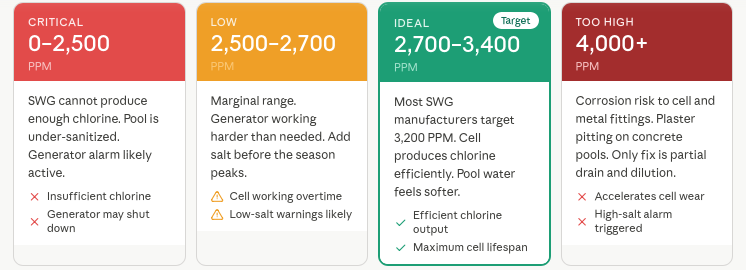
The consequences of wrong salt levels go beyond inconvenience. Too little salt (below 2,500 PPM) and your salt chlorine generator (SWG) cannot produce enough chlorine. The cell works harder, throws low-salt warnings, and eventually shuts down. You end up with a pool that looks clear but is not sanitized. Too much salt (above 4,000 PPM) starts to corrode your cell, your metal fittings, and if you have a concrete or plaster pool, it begins pitting the surface over time.
The sweet spot for most residential saltwater pools is 2,700 to 3,400 PPM, with 3,200 PPM being the most common manufacturer recommendation. Before you add a single bag of salt or adjust your system, you need to know exactly where your water sits right now.
That number has to come from a test. Not a guess. Not memory from last season. A test.
There are four good ways to get that number, each with different tradeoffs for accuracy, cost, and convenience. Here is how each one works.
Method 1: Salt Test Strips (AquaChek, Clorox): How to Use and Read Them
Salt test strips are the most accessible option. You can find them at Home Depot, Amazon, pool supply stores, and most hardware shops for around $10-15 per pack. They are fast (results in 3-5 minutes), require no equipment, and they travel well if you manage multiple pools or check your pool when you are away from home.
That said, they have real accuracy limits. Most salt test strips carry an accuracy window of roughly +/- 10%, which at 3,000 PPM means your real reading could be anywhere from 2,700 to 3,300 PPM. For a rough check to confirm your pool is in a reasonable range, that is fine. For precision dosing before adding salt, digital testing gives you a better foundation.
There are two major brands you will encounter: AquaChek White Salt Titrators and Clorox Salt Test Strips. Both work differently from standard dip-and-read pool strips, and the process trips people up the first time.
The AquaChek Salt Test Strip Color Chart Explained
AquaChek White Salt Titrators (the ones in the white plastic vial) use a titration method, not a simple color pad comparison. Here is the step-by-step process:
Fill a small specimen cup with about one inch of pool water drawn from at least wrist-deep. Do not take a sample near a return jet or the skimmer.
Insert the lower end of the white strip into the water. Keep the top half completely dry. This is important. Wetting the top section gives you a false reading.
Leave the strip in the water without touching it. Watch the bottom. The yellow indicator band near the base of the strip will begin turning black as the strip detects sodium chloride.
As the strip absorbs salt, the dark area creeps upward along a numbered scale printed on the strip itself. The movement slows and stops after 3-5 minutes.
When movement has fully stopped, remove the strip and note the highest number the dark portion reached.
Take that number and cross-reference it against the chart printed on the side of the bottle. The chart translates the strip's positional reading (which runs roughly 1 to 8) into PPM values.
Here is what the AquaChek chart covers in practice:
A strip reading between 1 and 2 corresponds to salt levels below 800 PPM. Your pool is severely under-salted and your SWG will likely be shut down or in alarm mode.
A reading around 2 to 3 puts you in the 800-1,500 PPM range. Still critically low. You need a substantial salt addition before your generator can function.
Between 3 and 4, you are typically looking at 1,500-2,200 PPM. Still below the safe threshold for most SWG systems.
The 4 to 5 range covers roughly 2,200-2,800 PPM. You are approaching acceptable levels but still short of the 3,200 PPM target most manufacturers specify.
Between 5 and 6, expect readings around 2,800-3,200 PPM. This is the lower edge of the ideal zone for most residential salt pools.
The 6 to 6.5 range corresponds to approximately 2,900-3,400 PPM and represents the sweet spot. This is where you want to be.
Above 6.5 to 7, you are looking at 3,400-4,000 PPM. Slightly elevated but acceptable for most systems.
At 7 and above, approaching the 8 mark, you are at 4,500-7,000 PPM. This is too high. Most SWGs will show a high-salt error and reduce output.
One important note: AquaChek updates its bottle charts periodically, and the chart is specific to the strips in that container. Do not use a chart from a different batch or a chart you found online. The chart that came with your current bottle is the one to use.
The Clorox Salt Pool Test Strips Explained
Clorox makes a simpler dip-and-read salt test strip that works more like a traditional pool strip than the AquaChek titration method. These are easier for beginners but cover a narrower measurement range.
The process:
Dip the strip into pool water for about 1-2 seconds. Do not shake it off after removing.
Hold the strip level for 15 seconds.
Compare the color of the salt pad on the strip to the color chart on the bottle.
The Clorox color chart typically shows four or five color blocks ranging from a pale yellow/cream at the low end (representing levels below 2,000 PPM) through progressively deeper shades. A tan or medium gold color on the strip corresponds to roughly 2,500-3,000 PPM, which is approaching ideal range. A deeper gold-brown indicates 3,000-3,500 PPM, which is in the target zone. A dark brown or amber reading typically signals 4,000 PPM and above, meaning your pool may be over-salted.
Clorox strips do not give you a specific PPM number from the strip itself. You are working by color match, which means lighting conditions, color perception, and strip freshness all factor into how accurate your reading is. For most homeowners doing a monthly check, they are a quick and convenient tool. For anything more precise, step up to a digital meter or get a lab test from your pool store.
Method 2: Digital Salt Tester / Salinity Meter
A digital salt tester (sometimes called a handheld salinity meter or TDS/salinity pen) is the most accurate DIY testing method available to the average pool owner. These devices use electrical conductivity to measure how much dissolved salt is in the water, and they give you a direct PPM reading on a small LCD screen.
Accuracy is typically within +/- 1-2%, far tighter than test strips. At 3,200 PPM, that means your error margin is less than 65 PPM in either direction. That kind of precision is genuinely useful when you are trying to decide whether to add half a bag of salt or a full one.
How they work:
Dip the electrode tip into a small cup of pool water, or submerge it directly in the pool. The device passes a small electrical current between two probes. The resistance to that current is inversely proportional to the salt concentration. Higher salt means lower resistance, which translates to a higher PPM reading on the display. Results usually appear in 5-10 seconds.
Models worth looking at:
The Apera Instruments EC20 and SX614 are among the most trusted in the pool and aquaculture communities. The SX614 specifically has a built-in temperature compensation feature that automatically adjusts readings for water temperature, which matters because conductivity changes with temperature. Without temperature compensation, you can get different readings at 60F versus 85F even if the actual salt level is identical.
The HM Digital COM-80 and Bluelab Truncheon are also popular. The COM-80 is compact and inexpensive ($25-30). The Bluelab is overkill for a home pool but is extremely durable.
For a simple home pool, any mid-range salinity pen with ATC (automatic temperature compensation) in the $20-50 range will do the job.
Calibration is required. Most digital meters ship with a calibration solution or require you to use a known-concentration solution to zero the device before use. Check the instructions. A meter that has not been calibrated in 6 months may drift by 200-400 PPM in its readings without you knowing it.
Method 3: Your SWG's Built-In Display
If you have a salt chlorine generator, it almost certainly has some form of salt level indicator. Depending on the model, this may be a simple three-zone LED bar (Low, OK, High), a numeric PPM readout on a digital display, or a value shown in the system's control panel app.
The built-in display is the most convenient tool available. You do not need to buy anything, you can check it at any time, and for day-to-day operation, it is good enough to tell you whether things are in a reasonable range.
The catch is that most SWG salt readings are not actual measurements in real time. They are estimates derived from cell voltage, current draw, and water temperature using a pre-programmed algorithm. The system infers salt level from how hard the cell is working to produce chlorine, not from directly measuring the salt concentration in the water.
What that means in practice: if your cell is old and the plates are partially scaled, the cell has to work harder to produce the same amount of chlorine. The system interprets that extra effort as "low salt" and shows you a lower reading than the water actually contains. The reverse is also true. A clean, new cell may read salt levels slightly higher than the true value.
How to use the SWG display correctly:
Use it as a trend indicator, not a precision measurement. If it shows 3,200 PPM today and 2,900 PPM two weeks later with no rain dilution or water additions, that trend is real. But a one-time reading of 2,750 PPM on an older cell does not definitively mean your water is under-salted.
Calibrate your SWG display periodically by testing your water with strips or a digital meter and comparing the result to what the panel shows. Many manufacturers include a manual offset adjustment in the control settings. If your independent test shows 3,100 PPM and the display shows 2,800 PPM, you can offset the display by +300 PPM so future readings match reality.
For adding salt, always confirm with an independent test before you dose. SWG display + test strip confirmation is a solid two-step process that most experienced pool owners use
Method 4: Free Pool Store Water Test
Most brick-and-mortar pool supply stores offer free water testing, usually as a way to get you in the door and sell you chemicals. Leslie's Pool Supplies is the most widely available chain in the United States, and they test salt along with a full chemistry panel for free.
The store's equipment is typically a professional-grade photometer or digital analyzer. Accuracy is equivalent to or better than a home digital tester. And because the test includes your full water chemistry, including pH, alkalinity, free chlorine, cyanuric acid, and calcium hardness, you get a complete picture of what your pool needs, not just the salt number.
The downsides are convenience-based. You have to transport a water sample (most stores want at least a few ounces collected in a clean container), drive to the store, and wait for results. The process takes 20-40 minutes start to finish. For a monthly check or before a seasonal salt addition, that investment is worth it. For a quick check on a Sunday afternoon before you want to swim, a set of strips is the faster call.
A few tips for getting accurate store test results:
Collect your sample from at least 18 inches below the surface and away from return jets. Morning water before the pump has run is often the most representative sample.
Bring the sample in within 30 minutes of collection. Water chemistry, especially pH and chlorine levels, begins to drift after collection. The fresher the sample, the more accurate the results.
Store your sample in a clean plastic container, not a glass jar and not an old chemical bottle. Residue from prior use can contaminate the reading.
What to Do After You Get Your PPM Reading
Once you have your salt level in PPM, the next step is figuring out exactly how much salt to add, if any. This is where most people either over-correct (add a full bag when half a bag would do) or under-correct (add a little, wait, add more, wait, cycle endlessly).
The amount of salt you need to reach your target level depends on three variables: your current PPM reading, your target PPM, and your pool's total water volume in gallons. The math is straightforward but pool volume calculations can be tricky depending on your pool's shape.
Calculate exactly how much salt to add once you know your gallons enter your current reading, target PPM, and pool size, and it tells you exactly how many pounds to add.
After you have added salt, wait at least 24 hours with the pump running to allow it to fully dissolve and circulate before retesting. Undissolved salt sitting on the pool floor will not show up in your test strip or digital meter reading.
Testing salt is just one piece of staying on top of your pool's chemistry for the full rundown, check out our maintenance checklist.
For a complete walk through of how to calculate and add salt safely, see our full guide on how much salt to add to different pool sizes.
Frequently Asked Questions
How often should I test my pool's salt level?
For most homeowners, once a month is sufficient during the swimming season. Test more frequently after heavy rain, after adding fresh water to compensate for evaporation, or if your SWG starts throwing low-salt alarms.
Can I use regular pool test strips to check salt?
No. Standard 4-in-1 or 5-in-1 pool strips measure pH, chlorine, alkalinity, and cyanuric acid. They do not test for sodium chloride. You need a strip specifically labeled for salt testing, such as the AquaChek White Salt Titrators or a dedicated salt tester.
My SWG says my salt is fine but my strips say it is low. Which one is right?
Neither is definitively right. Cross-reference both with a third method, either a digital tester or a pool store test. The SWG display can drift due to cell age and scaling. The strips can be inaccurate if they are old, stored in humid conditions, or read in poor lighting. When two methods disagree by more than 500 PPM, a third reference point resolves the conflict.
Can I test salt level with a regular TDS meter?
Technically yes, but with major caveats. A TDS meter measures all dissolved solids in the water, not just salt. Pool water contains many dissolved compounds: cyanuric acid, calcium, magnesium, and various pool chemicals. Using a basic TDS reading as a proxy for salt level in a treated pool will give you an inflated and unreliable number. Use a meter specifically calibrated for sodium chloride or a dedicated salt test method instead.
Was this article helpful?