CYA Levels for Saltwater Pools: What Stabilizer to Use and How Much
TL;DR:
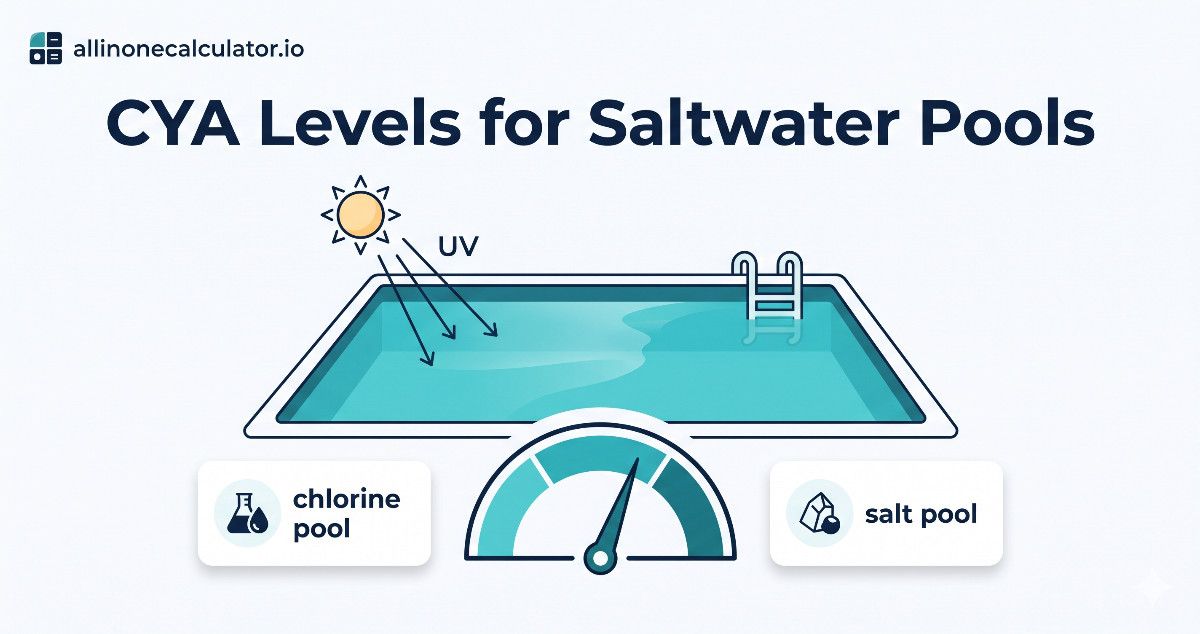
CYA (cyanuric acid) is what keeps chlorine from burning off in sunlight, but it works completely differently for saltwater pools than for traditional chlorine pools. Standard chlorine pools should sit around 30 to 50 ppm CYA. Saltwater pools should run higher, generally 70 to 80 ppm, since the salt cell produces chlorine continuously and needs more sun protection to keep up. Too much CYA and your chlorine stops working even though your test looks "fine." The only real fix for high CYA is diluting the water, there's no chemical shortcut.
If you've searched this topic before, you've probably noticed every source gives a slightly different saltwater CYA range, some say 50 to 80, others say 60 to 90, others say a flat 70 to 80. That's not one of them being wrong exactly, it's that CYA guidance has shifted over the past few years as more pool techs push for lower numbers across the board. We'll give you the range that fits current best practice for most residential saltwater pools and explain why the "right" number depends a bit on your specific setup.
What CYA does in a pool (UV protection for chlorine)
Cyanuric acid, also called stabilizer or conditioner, protects chlorine molecules from breaking down under UV light. Without any CYA in the water, sunlight can destroy a large share of your free chlorine within a couple of hours on a sunny day, which means you'd be adding chlorine constantly just to keep up with the sun, not with actual sanitizing demand.
Here's the mechanism in plain terms: CYA forms a loose, temporary bond with chlorine molecules. That bond shields the chlorine from UV rays while still allowing it to release slowly and keep disinfecting. Think of it less like a coating and more like a holding pattern, chlorine bound to CYA isn't gone, it's just protected and released gradually instead of all at once.
This is exactly why indoor pools with no sunlight exposure generally don't need CYA at all, and adding it there can actually work against you by suppressing chlorine for no benefit.
Ideal CYA range for salt pools vs. chlorine pools
Standard chlorine pools (using liquid chlorine, trichlor tablets, or cal-hypo): keep CYA between 30 and 50 ppm. This range gives chlorine enough sun protection without weakening its sanitizing power too much.
Saltwater pools: keep CYA between 70 and 80 ppm. The reason saltwater pools need more is straightforward once you think about how a salt chlorine generator works. It produces chlorine continuously, in small amounts, all day long while the pump runs, rather than one large dose like you'd add manually. That constant low-level chlorine is exposed to sunlight nonstop, so it needs more stabilizer protection to avoid burning off before it has a chance to do its job.
A quick note on why the range varies depending on where you look: some manufacturers and pool techs recommend as low as 50 ppm for salt pools, others go as high as 90 ppm. The 70 to 80 ppm range reflects current consensus from most SWG manufacturers, but always check your specific generator's manual, since some units are calibrated with that range in mind.
Whatever your CYA number actually is, free chlorine needs to scale with it. The widely used rule of thumb is that free chlorine should be roughly 7.5% of your CYA level. At 40 ppm CYA, that's about 3 ppm FC. At 80 ppm CYA (a typical saltwater target), that's about 6 ppm FC. This is the part a lot of guides skip, and it's the reason two pools can have "the same" CYA reading but completely different chlorine demand.
Pool stabilizer dosing chart
The standard rule most pool techs use: 13 ounces of granular cyanuric acid raises CYA by 10 ppm in a 10,000-gallon pool. Scale that up or down based on your actual pool volume.
Pool size and ounces of stabilizer needed to raise CYA by 10 ppm:
Pool Size (Gallons) | Approx. Amount (oz) | Approx. Amount (lb) |
|---|---|---|
5,000 | 6.5 oz | 0.4 lb |
10,000 | 13 oz | 0.8 lb |
15,000 | 19.5 oz | 1.2 lb |
20,000 | 26 oz | 1.6 lb |
25,000 | 32.5 oz | 2.0 lb |
30,000 | 39 oz | 2.4 lb |
If you need a different ppm increase than 10, just scale proportionally, for example a 5 ppm increase needs half the amount listed above.
A few things worth knowing before you dose:
CYA dissolves slowly. Liquid CYA typically reaches its final reading within about 24 hours. Granular CYA can take 5 to 7 days to fully dissolve and show an accurate test result, so don't panic and add more if your test looks low the day after dosing, wait it out first.
Always add CYA to water, never the reverse, and dissolve it in a bucket before adding it to the pool if the product instructions call for pre-dissolving. Some granular CYA is poured directly into the skimmer instead, check your specific product's label.
You don't need to add pure CYA if you're already using stabilized chlorine. Trichlor and dichlor both add CYA along with chlorine every time you use them, which is convenient early on but is also exactly why CYA creeps up over a season without anyone adding it on purpose.
If you'd rather not do this math by hand every time, calculate exactly how much salt to add once you know your gallons salt and CYA targets are closely linked for saltwater pools, and getting one wrong usually means the other is off too.What happens if CYA is too high (over-stabilization)
This is where most "why is my pool not staying clear" mysteries actually start. When CYA climbs too high, generally above 100 ppm, chlorine becomes locked into that protective bond too heavily and can't release fast enough to disinfect effectively, even though a chlorine test still shows a normal-looking number.
Signs your CYA might be over-stabilized:
Your chlorine test reads "fine" but algae or cloudiness keeps coming back anyway.
You keep adding chlorine and it disappears fast, or doesn't seem to do anything.
You're using a lot more chlorine than you used to for the same pool and same season.
The most common cause by far is relying heavily on trichlor tablets as your main chlorine source, since every tablet adds CYA along with chlorine, and CYA doesn't break down or evaporate the way chlorine does. It just accumulates, season after season, until someone finally tests for it.
How to lower CYA (partial drain and refill)
There's no chemical product that reliably removes CYA from pool water. Despite what some "CYA reducer" products claim, their results are inconsistent at best, and most experienced pool techs don't rely on them. The only proven method is dilution, meaning you drain some water out and refill with fresh water that has zero CYA in it.
Here's the basic process:
Test your current CYA level accurately first. Don't estimate, since the amount you need to drain depends entirely on how far over target you are.
Calculate the percentage of water to remove. As a rough example, if your CYA is at 100 ppm and your target is 50 ppm, you need to remove and replace about half your pool's volume, since dilution works proportionally.
Drain from the bottom if possible. CYA tends to concentrate lower in the water column, so draining from the bottom (via a main drain or submersible pump) removes more CYA per gallon than draining from the surface.
Refill and retest after the water has circulated for several hours, not immediately.
Check your filter media afterward if levels were very high. CYA can linger in filter sand or cartridges, and in extreme cases it's worth backwashing or rinsing the filter thoroughly so it isn't slowly reintroducing stabilizer back into the water.
If you're closing or reopening for the season anyway, that's often the most practical time to handle a partial drain. Our maintenance checklist covers exactly when in your opening and closing routine this fits best.
CYA test kits and how to test
CYA is tested differently than most other pool chemistry, which trips up a lot of people the first time.
Turbidity-based test kits (the classic method): you fill a small tube with a reagent and pool water, then look down through the liquid at a black dot on the bottom. As CYA increases, the solution gets cloudier and the dot becomes harder to see. The point where the dot disappears corresponds to your CYA reading on the tube's scale. It's a bit old-fashioned, but it's reasonably accurate if you do it consistently.
Digital photometers: give a more precise, repeatable number and remove the "did I read that right" guesswork of the turbidity method, at a higher upfront cost.
Test strips: convenient, but generally the least accurate option for CYA specifically. If you're making real dosing decisions (especially before a partial drain), a turbidity kit or digital tester is worth the extra few minutes over a strip.
Since CYA stays fairly stable day to day, you don't need to test it as often as chlorine or pH, checking every 2 to 4 weeks during swim season is usually enough, with an extra check anytime you've done a big water replacement or relied heavily on stabilized chlorine for several weeks in a row. CYA is just one piece of the puzzle if you also want a refresher on how to test your current salt level using the same water sample, that guide covers the different test methods and their accuracy tradeoffs.
Was this article helpful?