EST vs SAT for Egyptian Universities: Which Score Gets You In Faster in 2026?
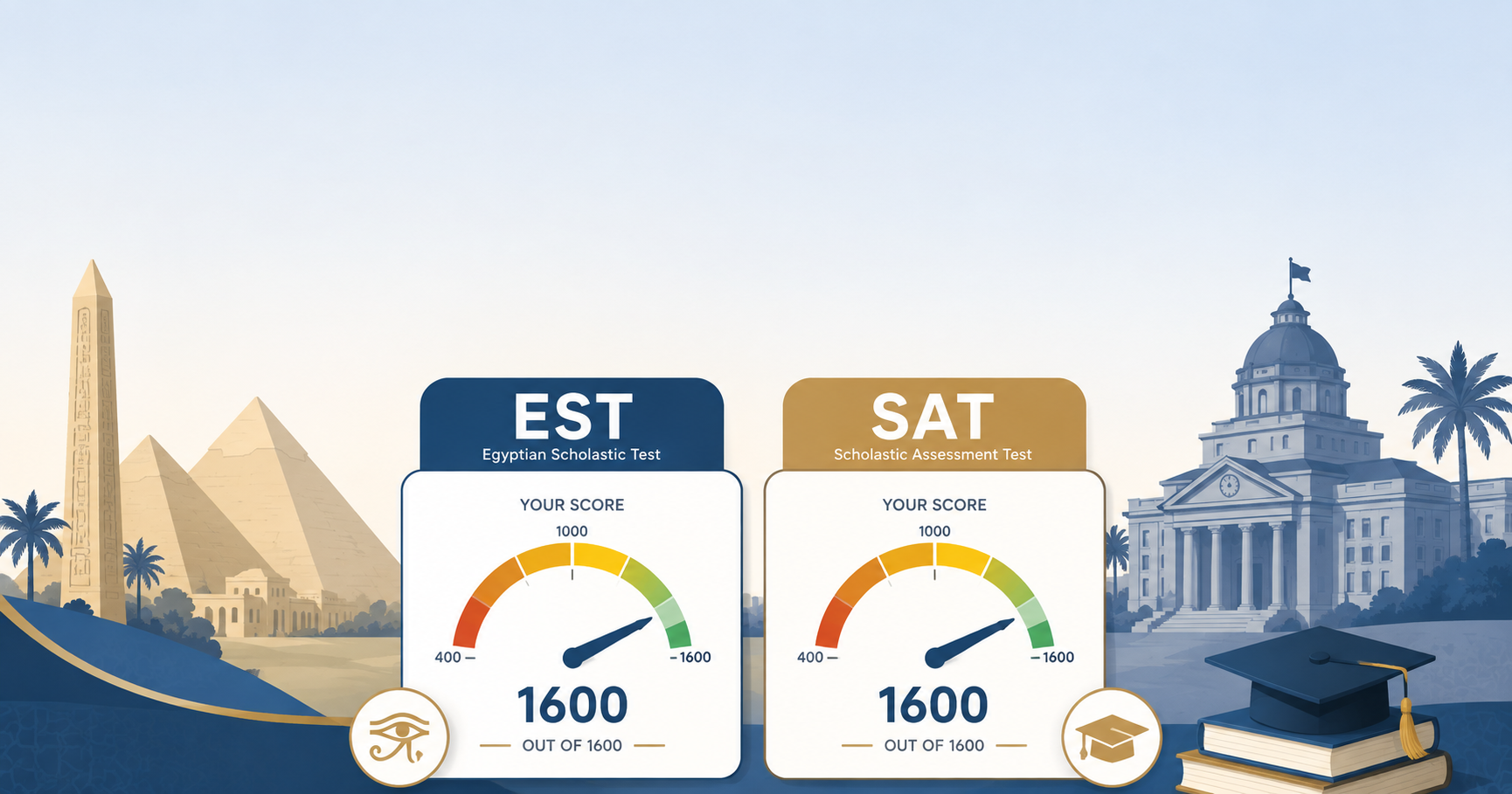
If you're an American Diploma student in Egypt planning your 2026 university applications, you've probably run into the same question every senior class asks itself around October: should I sit the EST or the SAT? Both tests feed into the same Tansik-style formula used by Egyptian public and private universities, both are scored out of 1600, and both show up side by side on faculty cutoff lists. But they are not identical experiences, and picking the wrong one for your situation can cost you a testing round you don't have time to spare.
This guide walks through how EST and SAT actually compare, which Egyptian universities accept which exam, how the two scores convert into your admission total, and two worked examples so you can see exactly how the math plays out. If you want to skip straight to the numbers, you can run your own scores through an EST calculator or SAT calculator for Egyptian universities and get your admission score and eligible faculties instantly.
EST vs SAT: The Real Differences
Both exams are used for the same purpose in Egypt: converting your American Diploma performance into a single admission score that public and private universities use for Tansik-style ranking. Where they differ is in who runs the exam, how you access it, and how the scoring philosophy behaves.
Ownership and administration. The SAT is owned and administered globally by the College Board. The EST is developed and overseen by an academic board based in the United States and is built specifically for students in Egypt, Jordan, Saudi Arabia, the UAE, and Libya who are enrolled in American Diploma or similar international programs.
Format. The SAT is now fully digital, adaptive, and roughly two hours and fourteen minutes long, split into Reading & Writing and Math modules that adjust difficulty as you go. The EST is not adaptive. It runs closer to three hours without the optional essay, split across Literacy I (Writing and Language), Literacy II (Reading Comprehension), and Math, for a total of around 125 questions.
Scoring scale. This is the part most students get wrong, and it's good news: both exams use the identical 400 to 1600 total scale, with each section (Reading/Writing and Math) scored from 200 to 800. A 1300 on the EST and a 1300 on the SAT plug into the Egyptian university formula exactly the same way.
Guessing penalty. Neither exam penalizes wrong answers. Your raw score is simply the number of questions you get right, so there's no reason to leave anything blank on either test.
Availability and retakes. The EST runs roughly six rounds a year inside Egypt, which makes it far easier to retake if one section underperforms. Because English and Math content overlap heavily between the two tests, many students prepare for both with the same study system, then decide based on scheduling. The SAT requires either traveling to an international test center or catching one of the limited domestic administration windows, which makes retakes logistically harder for students who are short on time before Tansik deadlines.
Recognition. The SAT is recognized by universities worldwide, so it's the better choice if you're keeping international options open alongside your Egyptian applications. The EST is built for and only recognized by Egyptian universities and a handful of regional institutions, but for a student who is committed to studying in Egypt, that narrower focus isn't a downside. It just means the exam is optimized for exactly the formula you're being scored against.
Which Egyptian Universities Accept EST vs SAT
The short answer is that almost every Egyptian university accepting American Diploma students takes both EST and SAT interchangeably, because the Ministry of Higher Education and the Supreme Council of Egyptian Universities apply the same formula to either score. The practical differences show up in the minimum thresholds each institution sets.
Public universities under Tansik coordination. Cairo University, Ain Shams, Alexandria University, and other government universities require a minimum Test 1 (EST 1 or SAT 1) score of around 1050 to be eligible at all. Below that threshold, your application isn't scored for government-university placement regardless of GPA.
AUC (American University in Cairo). AUC accepts SAT scores directly, or its own internal admissions test, alongside GPA and English proficiency evidence. Students on the American Diploma track are generally expected to submit SAT or EST results as part of a standard application.
GUC, BUE, MSA, MIU, MUST, Nile University, Heliopolis, Future University. These private, English-medium universities generally accept either EST or SAT under the same private-university formula, since they operate within the Supreme Council of Egyptian Universities framework. BUE, for example, publishes a minimum SAT1/EST1 score of 800 to apply, with EST2 (or SAT2) needing to reach 900 to be considered for subject-specific tracks like Dentistry or Engineering.
AASTMT (Arab Academy for Science, Technology and Maritime Transport). Accepts SAT, ACT, or EST for American Diploma applicants, following the same Supreme Council regulations, with a second test (SAT II, ACT II, or EST II) required for tracks like Medicine, Dentistry, and Pharmacy.
Higher institutes. These carry the lowest bar, with a Test 1 minimum around 890, and follow the same formula structure as government universities.
Because acceptance is nearly universal across both exams, the decision usually comes down to logistics (how many retake opportunities you realistically have before deadlines) rather than which universities will "let you in" with one exam over the other.
EST to SAT Conversion: What You Actually Need to Know
Here's the part that surprises most students: there is no conversion needed between EST and SAT. Both exams report a total score on the same 400 to 1600 scale, and Egyptian universities plug that number into the identical formula regardless of which exam produced it. An EST 1 score of 1200 and an SAT 1 score of 1200 carry exactly the same weight in your admission total.
Where a real conversion matters is if you sat the ACT instead of either test, since the ACT uses a completely different 1 to 36 scale. Universities that accept ACT scores convert them to their SAT/EST equivalent before applying the formula. A rough sense of how that mapping works:
ACT Score | SAT/EST Equivalent |
|---|---|
21 | 1090 |
24 | 1190 |
27 | 1290 |
30 | 1380 |
33 | 1480 |
36 | 1600 |
If you took the ACT, run it through a full ACT-to-SAT conversion table before estimating your admission score, since the mapping isn't linear across the full range.
Step-by-Step: Calculating Your Admission Score
Egyptian universities use one of three formulas depending on the type of institution, and the same formula applies whether your Test 1 and Test 2 scores came from the EST or the SAT.
The core structure:
If Test 1 is 1090 or higher, it's weighted more heavily than if it falls below 1090.
Test 2 only counts if it clears a minimum threshold that depends on the institution type.
GPA (on Egypt's 20 to 40 scale) is added directly, with no additional scaling.
Example 1: Government University, EST Route
Say you scored EST 1 = 1200, EST 2 = 1150, and your GPA is 36 out of 40.
Government universities use: (Test1 × 69 / 1600) + (Test2 × 15 / 1600) + GPA, using the higher multiplier because Test 1 is above 1090.
Test 1 contribution: (1200 × 69) / 1600 = 51.75
Test 2 contribution: Since EST 2 is above the 1100 threshold for government universities, it counts. (1150 × 15) / 1600 = 10.78
GPA contribution: 36 (added directly)
Total admission score: 51.75 + 10.78 + 36 = 98.53
That total gets compared against each faculty's published cutoff to see which government programs you qualify for.
Example 2: Private University, SAT Route
Say you scored SAT 1 = 1400, SAT 2 = 950, and your GPA is 34 out of 40.
Private universities use: (Test1 × 75 / 1600) + (Test2 × 15 / 1600) + GPA, again using the higher multiplier since Test 1 clears 1090.
Test 1 contribution: (1400 × 75) / 1600 = 65.63
Test 2 contribution: Since private universities only need SAT 2 above 900 to count, this 950 qualifies. (950 × 15) / 1600 = 8.91
GPA contribution: 34 (added directly)
Total admission score: 65.63 + 8.91 + 34 = 108.54
Notice the private-university formula weights Test 1 more heavily (75 instead of 69) and has no minimum Test 1 requirement to apply at all, which is why a strong SAT or EST score moves the needle further at private institutions than at government ones.
If you'd rather skip the manual arithmetic, plugging these same numbers into an EST calculator or SAT score calculator for Egyptian universities gets you the total instantly, along with a list of which faculties your score currently qualifies for.
So Which One Gets You In Faster?
If you're only applying to Egyptian universities and want the most flexibility to retake and improve your score before Tansik deadlines, the EST is generally the faster path. Six administration rounds a year inside Egypt means you can superscore your best English sitting with your best Math sitting without booking international travel. If you're keeping the door open to universities outside Egypt, or you're applying somewhere like AUC that leans on SAT submissions specifically, sitting the SAT (in addition to or instead of the EST) protects that option, since the EST isn't recognized outside the region.
For most students committed to studying in Egypt, the practical answer is: take the EST for its scheduling flexibility, and only add the SAT if a specific target university asks for it by name or you want international backup options.
FAQ
Do Egyptian universities prefer EST over SAT, or vice versa? No. Because both exams report on the same 400 to 1600 scale and feed into the identical formula, neither is weighted differently. Universities look at the number, not which exam produced it.
Can I mix an EST score with an SAT score on the same application? Generally no. Universities expect Test 1 and Test 2 to come from the same exam family. Check your target university's admissions page if you're considering combining scores from different tests.
Is the SAT still offered inside Egypt? Digital SAT availability inside Egypt has been limited over the years, which is part of why the EST was developed specifically for Egyptian and regional American Diploma students. Many students who want an SAT score end up sitting it at an international test center.
What's the minimum score to qualify for a government university? Test 1 (EST 1 or SAT 1) needs to be at least 1050 to be eligible for government-university placement at all. Higher institutes have a lower bar, around 890.
Does a higher GPA make up for a lower EST or SAT score? GPA is added directly to your total without scaling, so it matters, but it can't offset a Test 1 score that falls below a university's minimum threshold, since those applications aren't scored at all below the cutoff.
How many times can I retake the EST or SAT? The EST offers roughly six rounds per year in Egypt, and most students retake it at least once to superscore their English or Math section. The SAT can also be retaken, but scheduling around international test centers makes multiple attempts harder to fit before application deadlines.
Was this article helpful?